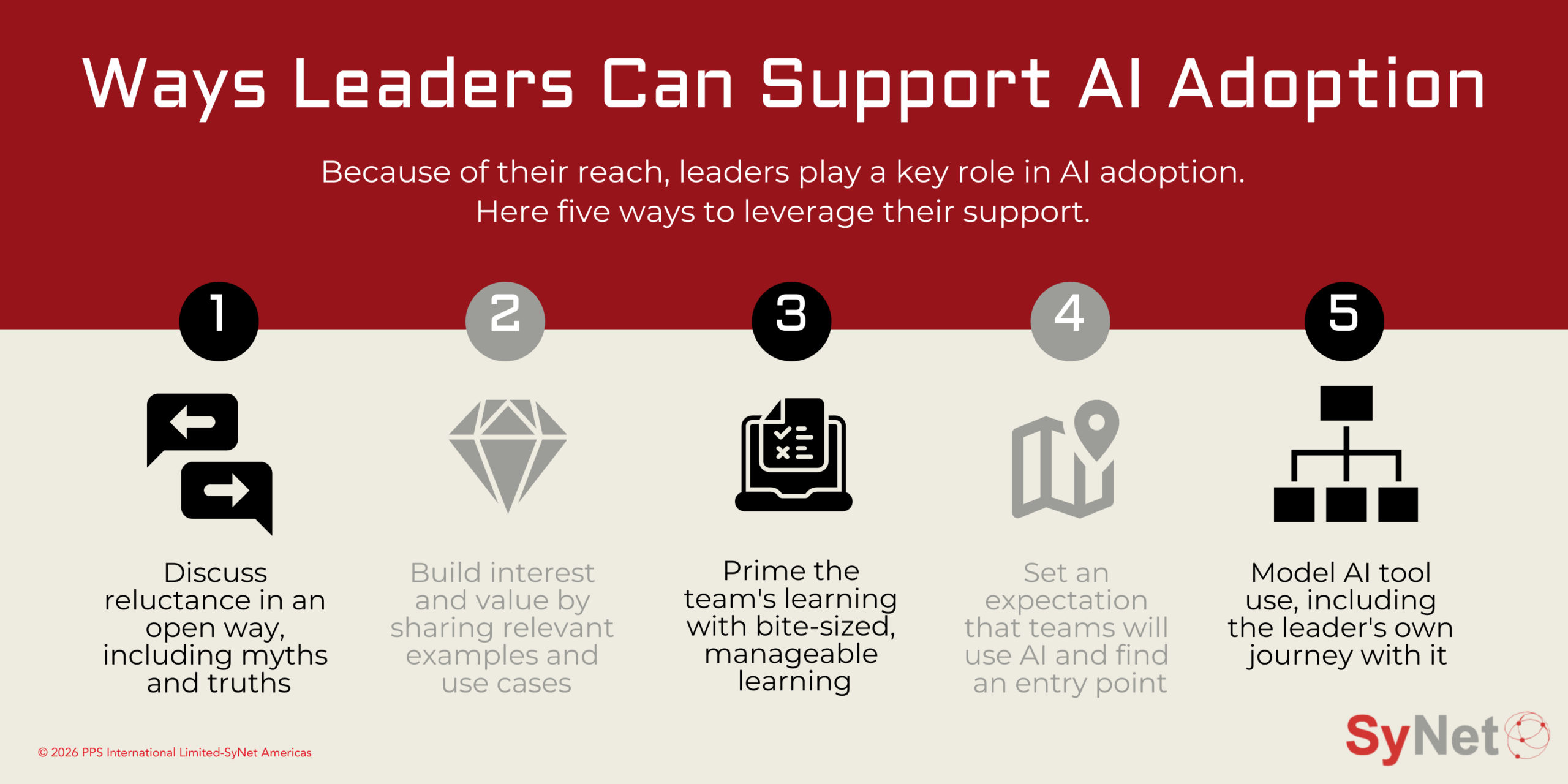
Organizations rank successful AI adoption in their top priorities for the coming year. Because of their reach within the organization, leaders play a key role in AI adoption. While many leaders are being told to adopt and integrate AI into their work, most of their teams are not ready. Others are even resistant. This sets up a question for leaders who want to drive AI adoption: what to do?
Resistance to AI is rarely about the technology itself. It’s often about uncertainty. People want to know what it means for their role now and into the future. They may be concerned about AI diminishing their value to the organization. Others are willing to adopt AI in theory, yet resistant because of the inevitable drag that occurs on productivity when making a change to a well-working process.
Practical Ways Leaders Can Support AI Adoption
Through our work with thousands of leaders around the globe, we know that effective leaders do not force adoption. They guide by creating clarity, modeling value and increasing confidence. Practically speaking, effective leaders:
- Discuss reluctance in an open way. A good way to introduce and open discussions is to share your own initial concerns. Bring up myths and truths about AI. For example, AI supports automation of routine tasks and can diminish rote work. Using AI tools as thinking partners can strengthen individuals’ capabilities by sparking creativity and expanding on a partially formed idea or improving analysis to streamline decision making by summarizing large sets of data. Most professional work includes judgment, stakeholder management and ethical tradeoffs. Those remain human-centered activities.
- Build interest through relevance. Leaders who support AI adoption connect AI use directly to real projects and work. To make these connections, leaders can share use cases. For example, drafting communications, synthesizing information or preparing analyses using their team’s work. When people see how to use AI tools in their own work, adoption becomes tangible and even exciting.
- Prime the team’s learning. If your teams have limited use of AI tools, they may lack confidence to experiment, which is essential to learning and adoption. A way to boost confidence is for leaders to give learning assignments: watch a video on an available tool; partner with a peer to ‘play’ with the technology; attend a formal training session and report back.
- Set an expectation that teams will use AI. At the start of projects and assignments, leaders can give direction that individuals should experiment with AI to augment their work. Another approach is for leaders to discuss with their teams where the teams might leverage available AI tools. Using these and other ideas, adoption accelerates when leaders normalize usage.
Modeling Using AI Tools is Most Important
Above all, leaders will most support AI adoption by modeling its use. And contrary to perceptions, leaders don’t need to be experts in using AI tools in order to be strong role models for its use. In fact, it can be very powerful for leaders to learn alongside their teams. Because of this dynamic, leaders and teams can effectively attend training to support AI adoption side-by-side. Often, training and development professionals are concerned about putting leaders and their direct reports through training together. But, unlike other programs, such as giving feedback or handling conflict, for instance, the leader-direct report dynamic is less pronounced when learning about all things digital, including AI tools. Learn more about our support for AI adoption, including digital transformation programs and our Gen AI Playground case led by SyNet Americas (PPS International).
Successful AI adoption is not a technology rollout, it is a change management leadership opportunity. Leaders who clarify the role of automation and augmentation—and who intentionally build understanding and confidence—turn hesitation into capability.
See more of our Change & Transition corporate training programs, or contact us to learn how we can help your organization overcome AI adoption challenges.